
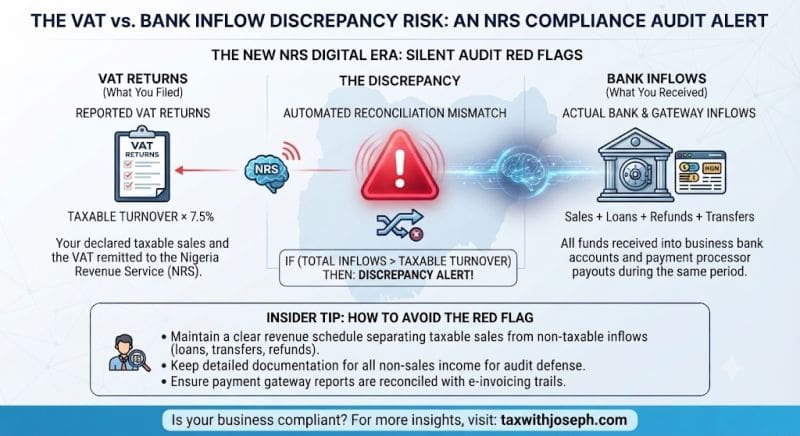
VAT vs Bank Inflows Audit Strategy
VAT vs Bank Inflows Audit Strategy
As an ex-insider, one of the fastest ways a business can get flagged for an automated audit by the Nigeria Revenue Service (NRS) is a mismatch between what you report on your monthly Value Added Tax (VAT) returns and the actual money hitting your bank accounts or payment gateways.
Please note that under automated data-matching systems, tax authorities don’t wait for a physical visit; their digital engines automatically cross-reference your VAT records against bank statements and payment processor payouts (like Paystack, Flutterwave, or bank accounts).
How the NRS Reconciles VAT to Bank Inflows:
The tax authority takes your total bank inflows and works backward to check if your declared taxable sales (and the VAT remitted) match up.
The Formula They Use:
If your Expected VAT Output is significantly higher than what you actually filed and paid, an automated discrepancy alert is triggered.
Where Businesses Get Into Trouble
Imagine you run an e-commerce or SME business selling gadgets and
what your bank statement reveals at the end of the year, (total of your business bank account and payment gateway dashboards) is a total inflow of ₦120 million.
However on your VAT returns you reported a total taxable turnover of ₦50 million and remitted the corresponding VAT.
Why the Gap Exists (And Why the NRS Flags It):
To you, the business owner, that ₦120 million total inflow is not entirely taxable sales. It includes:
1. Capital injection or loans from family ₦30 million.
2. Refunds given to customers for returned items ₦10 million.
3. Transfer of funds between your own company accounts ₦30 million.
4. Actual taxable sales of goods ₦50 million.
The Inside View:
While your reasons are entirely legitimate, the NRS automated system cannot read your mind or automatically know which credit alert is a loan versus a sales revenue. When it sees ₦120 million in total bank credits but only ₦50 million in taxable turnover, its algorithm flags your business for a discrepancy audit.
The Fix:
1. Maintain a Detailed Revenue Schedule: Never file VAT returns directly from raw bank statements without a reconciliation schedule. Keep a ledger that separates taxable sales from non-taxable inflows (loans, director’s capital, transfers).
2. Keep Third-Party Proof Ready:
If the NRS sends a desktop audit notice querying your bank inflows, your defense depends entirely on documentation—such as loan agreements, bank transfer memos for capital injections, and credit note logs for customer refunds.
3. Match Gateway Payouts to Invoices: Ensure that payouts from payment gateways reconcile cleanly with your e-invoicing records so that your digital paper trail matches your tax filings.
Want to protect your business?
If you are a startup or SME looking to audit-proof your financial structure against new digital mandates, send me a DM or book a compliance health check via the link in my bio.


About Post Author