
Nigeria Tax Audit Red Flags 2026: 6 Tips to Stay Compliant
The tax audit isn’t waiting for a letter anymore, it’s already reading your data
Under Nigeria’s reformed tax framework, audits are shifting from periodic, notice-driven exercises to continuous, data-triggered ones. The Nigeria Revenue Service (NRS) now cross-references e-invoicing data, bank transactions, payroll records, and filing history in real time. A “redflag” today isn’t a suspicious-looking figure a human reviewer spots months later, it’s a mismatch the system catches the same week it happens.
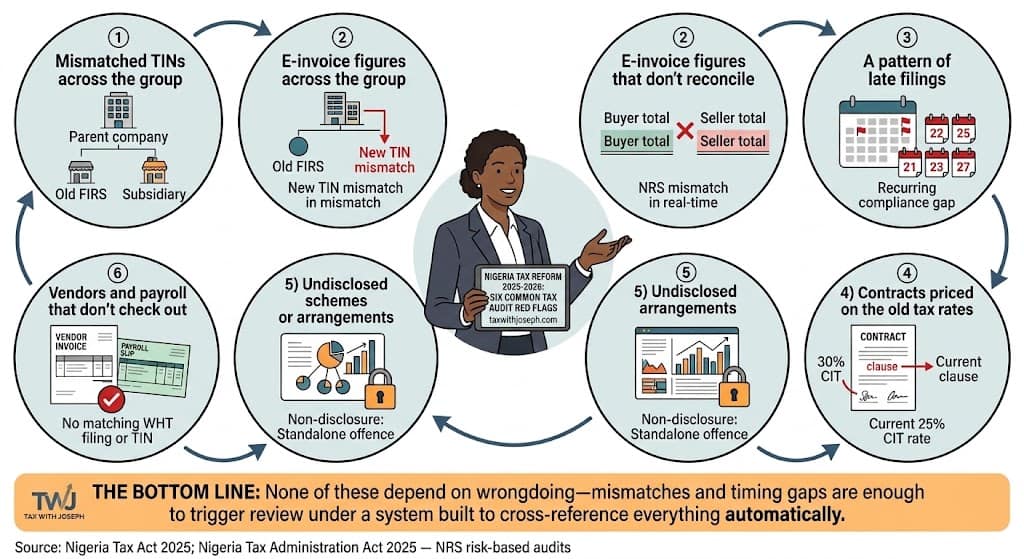
Here are six of the most common triggers under the new regime, shown as they actually play out and with the fix for each.
1. TINs that don’t match across the group
Sections 4–7 of the Nigeria Tax Administration Act make the Tax ID a single “digital passport”. A NIN for individuals, an RC/BN number for companies and every registration, filing, and bank account is expected to trace back to it.
The trigger: Benue Foods Ltd has three related entities. Two were re-registered under the new single-TIN system; the third, a distribution subsidiary set up in 2017, is still filing under its legacy FIRS number. When NRS cross-checks related-party disclosures against TIN records, the third entity doesn’t show up as connected, which reads as an undisclosed related party, not an admin oversight.
The fix: Audit every group entity’s TIN and registration profile against the unified NRS system before your next filing cycle, not after a query arrives.
2. E-invoice figures that don’t reconcile
Where e-invoicing applies, every invoice a seller transmits through the NRS Merchant Buyer Solution is matched against what the buyer booked. A gap between the two is visible to NRS immediately, not at year-end reconciliation.
The trigger: Bemgba Ltd issues an MBS-validated invoice for ₦15,000,000. Retail Co’s accounts team, still working from an old template, books ₦16,200,000 and VAT added twice by mistake. The mismatch sits in both companies’ returns and surfaces the moment NRS’s system compares the two.
The fix: Reconcile validated invoice totals against your books before the return is filed, not during a query response. Treat the Invoice Reference Number as the source of truth, not your internal ledger.
3. A pattern of late or inconsistent filings
A single late return used to draw a fine. Automated monitoring now looks for patterns and a pattern reads differently to the system than a one-off.
The trigger: A manufacturing company files its VAT return three days late in March, then again in July. Two isolated incidents few months apart. To the NRS’s automated monitoring, it’s a recurring compliance gap on the same taxpayer profile, exactly the kind of signal that moves a file from routine to reviewed.
The fix: Build a filing calendar with a named backup preparer for every return type, so one person’s absence never becomes a pattern in the data.
4. Contracts still priced on the old tax rates
The corporate income tax rate dropped to 25% under the 2026 reforms. Live contracts that still reference the old 30% rate, or pre-2026 VAT input-credit treatment, create a visible gap between what a contract assumes and what a return reports.
The trigger: A five-year supply agreement signed in 2024 has a withholding tax clause built around the old 30% CIT rate. The counterparty’s finance team never updated it. When NRS reviews the underlying tax provisioning against the actual return, the numbers don’t line up with either the contract or the current law and that gap itself becomes the question the auditor asks first.
The fix: Run a rate-assumption audit across every live contract, supply agreements, leases, loan facilities and update tax-rate and change-in-law clauses to the current regime.
5. Arrangements that were never disclosed
The 2026 rules treat non-disclosure of a reportable scheme as a serious offence in its own right, separate from whatever tax was or wasn’t owed underneath it.
The trigger: A group implemented a financing structure in 2023 that was tax-efficient but never formally disclosed. Under the current rules, discovery of an undisclosed scheme carries an administrative fine of up to ₦1,000,000, a further ₦1,000,000 plus ₦10,000 per day for failing to provide information on request, and exposure to criminal sanction of up to three years’ imprisonment on conviction with the advising accountant or lawyer also at risk of report to their professional body.
The fix: If a past scheme was never disclosed, voluntary disclosure now is materially better than discovery later realize that a standard audit is a different conversation from a triggered Tax Investigation.
6. Vendors and payroll that don’t check out
NRS now cross-references payroll data, withholding tax remittances, and bank transactions against the vendors and staff a business reports. A name on the payroll or the vendor list that doesn’t check out elsewhere in the system stands out.
The trigger: A construction firm engages a contractor for ₦50,000,000 of site work. The contractor has no verifiable TIN on record and withholding tax was never remitted against the payment. The payment shows up in the firm’s bank data with no matching WHT filing, a gap that’s now visible without anyone requesting a bank statement.
The fix: Verify every vendor’s TIN before onboarding and before the first payment, and confirm WHT is deducted and remitted in the same cycle, not reconciled retrospectively.
The bottom line
None of these six triggers depend on wrongdoing note that mismatches, timing gaps, and outdated paperwork are enough to move a file into review under a system built to cross-reference everything automatically.
The businesses that stay out of that queue are the ones treating reconciliation as a monthly habit, not a year-end scramble.


About Post Author
